
Antique prints hold a timeless appeal, offering a glimpse into the artistry, craftsmanship, and scientific documentation of past centuries. Whether you’re a seasoned collector or a first-time buyer, understanding what to expect when purchasing an antique print can help ensure you make an informed and satisfying acquisition.
Unpacking your Antique Print
Your print will arrive securely packaged in a rigid stay-flat mailer made from recycled materials. To open, simply remove the tape and lift the package tab at the top. Avoid using sharp objects, as they may damage the contents.
Inside, you’ll find an additional rigid layer of recycled material designed to protect the print from bending during transit. However, this material is highly acidic and should not come into direct contact with the artwork, as acidic surfaces can cause premature aging and embrittlement.
The print itself is enclosed in a biaxially-oriented polypropylene (BOPP) sleeve, a crystal-clear, acid-free protective covering with a low electrostatic charge—making it safe for long-term storage. Alongside the print, inside the sleeve, is an acid-free rag board specifically chosen for archival preservation of works on paper.
The sleeve is resealable and opens at the top, allowing you to safely remove and handle your print while protecting it from environmental factors such as humidity and airborne pollutants. For optimal preservation, we recommend keeping the print stored in its archival sleeve with the acid-free rag board until you are ready to frame it.
Understanding What Qualifies as an Antique Print
In the art world, an “antique print” generally refers to a printed image that is at least 100 years old. These prints were created using traditional printing methods such as engraving, etching, lithography, and woodcut. Unlike modern reproductions, antique prints are original works of art produced in the same era as their subject matter, often by skilled artisans or renowned publishers.
Identifying Authenticity and Print Type
When buying an antique print, it’s crucial to determine its authenticity and method of production. Here are some common types of prints you may encounter. Examining the impression left on the paper, the paper itself, and the quality of the ink can help verify authenticity. A lope is a useful tool in examining and identifying print types. If in doubt, consult a reputable dealer or an expert in printmaking techniques.
Engravings & Etchings
An antique engraving has a distinctive look shaped by the engraving process, which involves carving an image onto a metal plate and printing it onto paper. Engravings are made by cutting directly into a copper or steel plate with a burin (a sharp tool), producing fine, detailed lines. The lines are often thin and uniform, though cross-hatching (a series of intersecting lines) is used to create shading and depth.
Because engravings are printed with intaglio (ink pressed into recessed lines), they leave a slight indentation around the printed area, known as a plate mark.
Since ink sits in engraved grooves and is pressed into paper, antique engravings have rich blacks and clean white areas with sharp definition. Unlike lithographs (which have a softer, more fluid look), engravings appear precise and controlled.
Instead of smooth gradients, engravings use parallel lines, dots, or cross-hatching to create the illusion of shading.
Although engraved printing was deveoloped in the 15th century, it was not widely used in natural history art until the 16th century. Engraving was widely used until the 19th centry, and is still used by fine artist to create limited editions.

Detail of steel engraving from Swiss Scenery by James Cockburn.

Detail of hand-colored lithograph from A Natural History of British Moths created by Rev. Francis Orpen Morris in 1872.
Lithographs
Lithographs use a grease-based drawing process on a stone or metal plate, allowing for delicate shading, cross-hatching, and smooth tonal transitions. They often have a soft, hand-drawn quality with detailed textures.
Unlike modern glossy prints, antique lithographs have a flat, matte finish. The ink sits within the paper fibers rather than on top, creating a more integrated, natural look.
Early lithographs were often produced in black and white, with colors added by hand using watercolors. These hand-colored lithographs have slightly uneven coloration and visible brush strokes.
Unlike engravings, lithographs don’t leave a plate impression or indentation around the edges of the image.
Lithographs and chomolithographs were popular in natural history prints from the 1820’s to the 1890’s.
Wood Engravings
A chromoxylograph is a color wood engraving created using multiple blocks, each inked in a different color, to produce a full-color image. It was a popular printing method in the 19th century, especially for book illustrations, children’s books, and decorative prints.
Each color in the image is printed using a separate wood engraving block, carefully aligned (registered) to layer the colors correctly. Unlike hand-colored prints, chromoxylographs are entirely printed, making them more efficient for higher volume printmaking.
Unlike later chromolithographs, which used oil-based inks, chromoxylographs used water-based inks, resulting in soft, natural-looking colors.
Early examples often have a somewhat muted or pastel quality, with colors blending slightly due to the printing process.
Chromoxylographs were mostly produced in the 19th century.
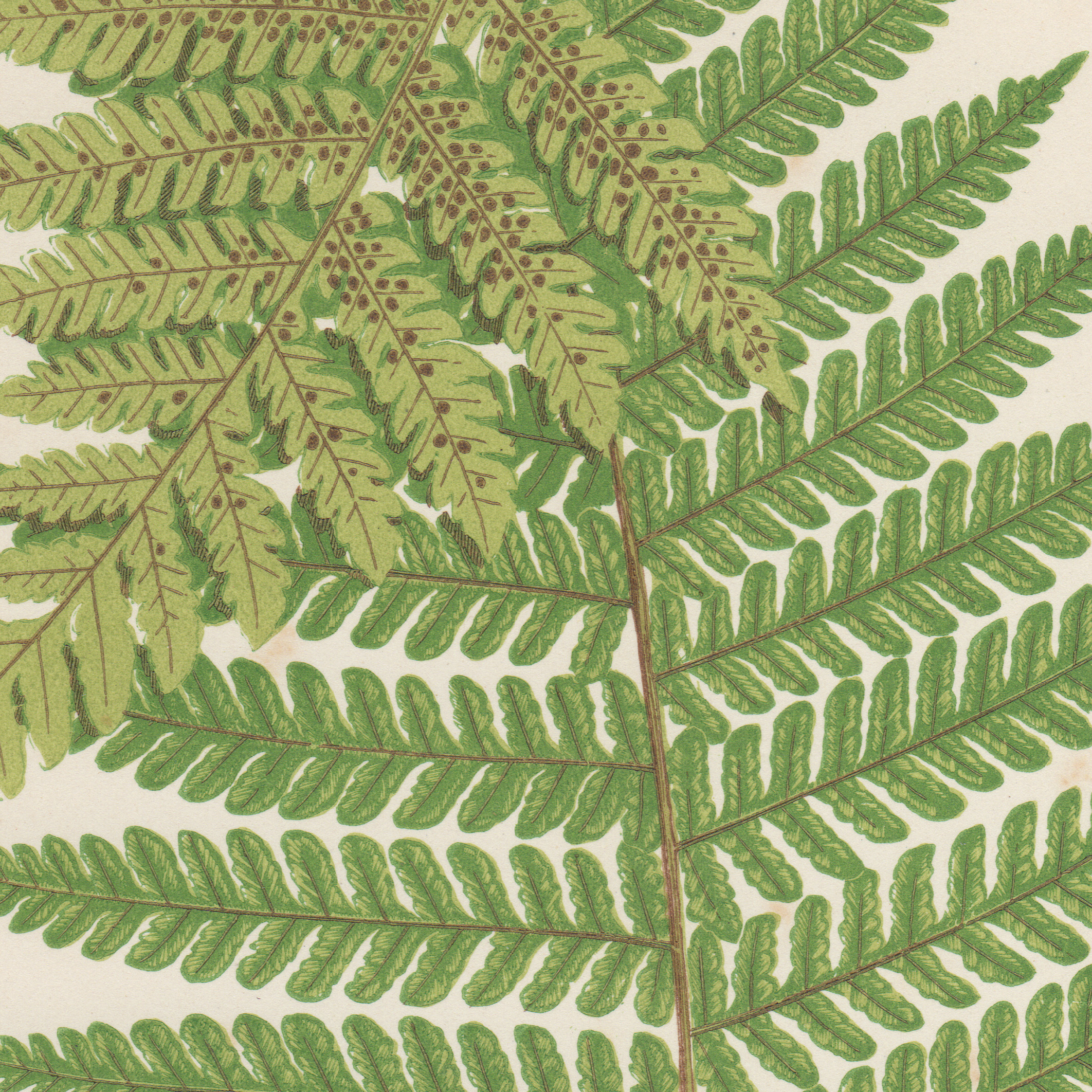
Chromoxylograph from Ferns: British and Exotic also referred to as Lowe’s Ferns created in 1872 by Alexander Francis Lydon.
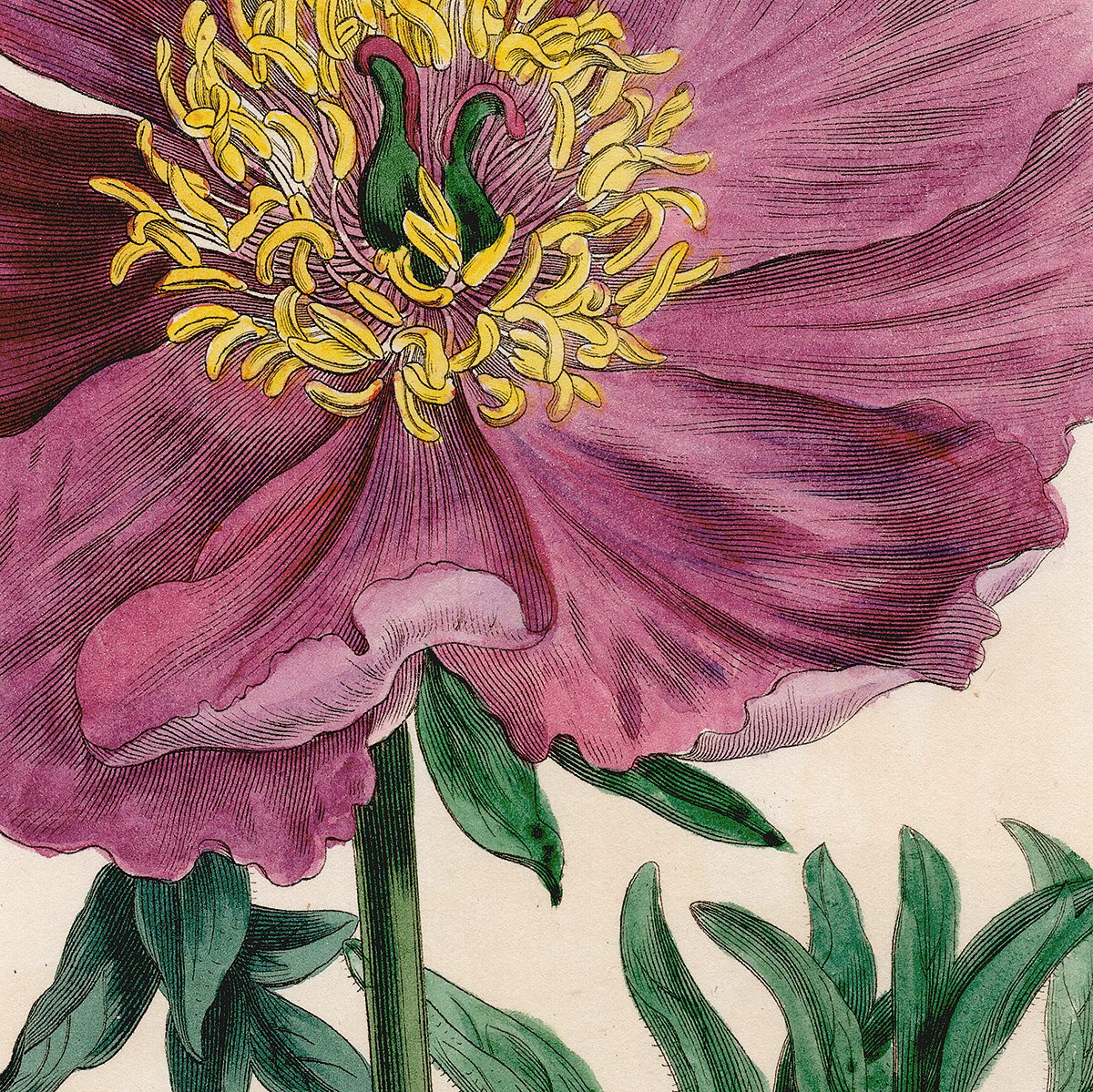
Hand-colored engraving from Curtis Botanical Magazine published in 1833.
Hand-Colored Prints
Identifying an antique hand-colored print involves looking for specific characteristics that distinguish it from modern reproductions or mechanically printed color images.
Hand-colored prints were tinted with watercolors or gouache applied by hand after printing. Look for slight variations in color intensity and areas where color may extend slightly outside the lines or appear lighter in some places. Under magnification, you may see brush strokes, especially in larger colored areas.
The black or sepia-toned printed lines should appear underneath the hand-applied color. In contrast, modern color prints often have uniform ink coverage and printed colors that perfectly align with the lines. Under magnification, color should not be made up of small dots, which indicate modern halftone or digital printing.
Condition and Conservation Considerations
Since antique prints are often over a century old, they can show signs of aging. While minor imperfections are common, excessive damage can reduce a print’s aesthetic appeal and worth. If conservation is needed, professional restoration can often stabilize or improve a print’s condition without compromising its integrity. Below are some common conditions that will help determine the age of a print.

Foxing
Small rust colored spots like those seen on the top part of the above print are common amoung antique prints. Foxing is often caused by humid environments.
Toning or Darkening
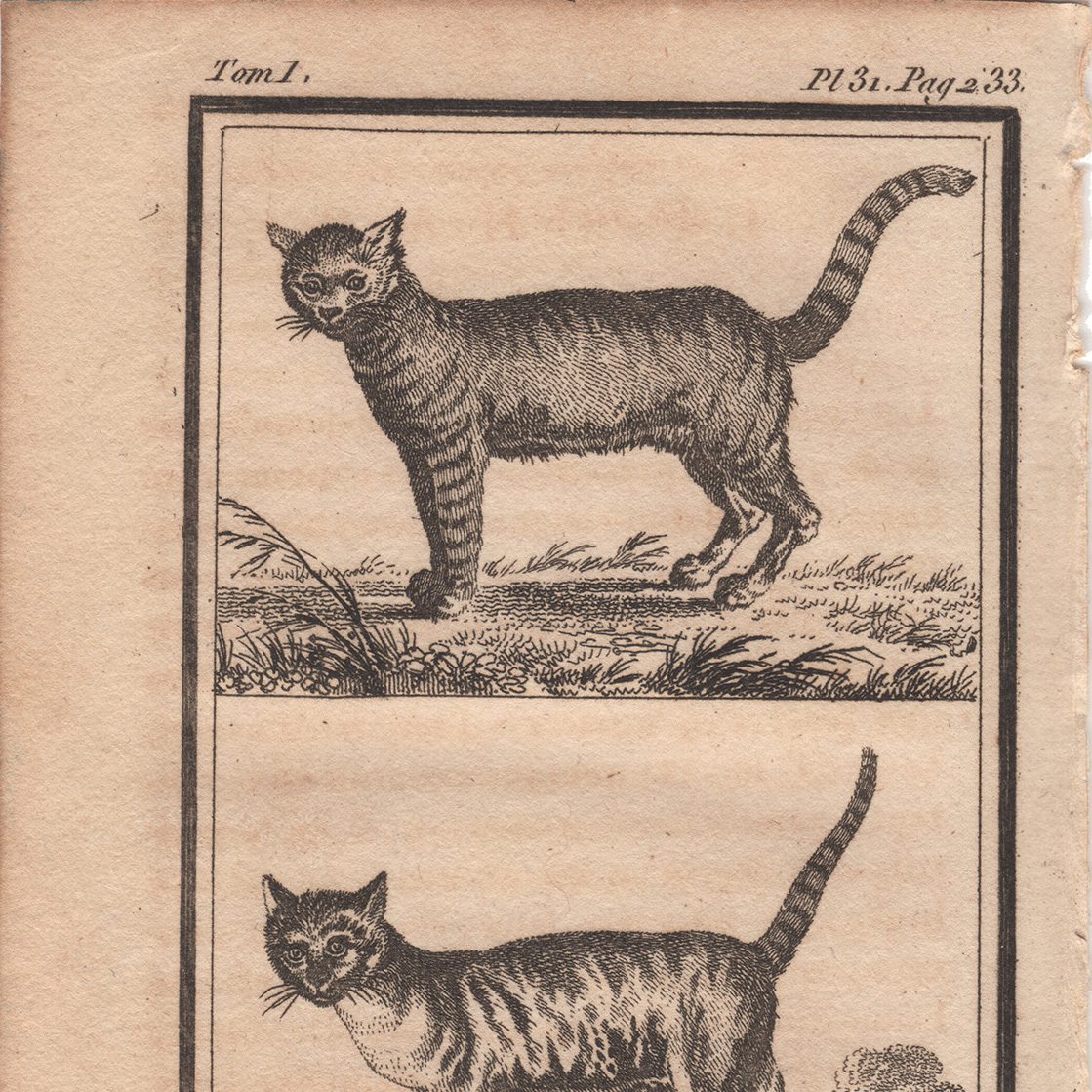
Paper becomes darkened and/or yellow with age, or when exposed to acid materials. This print is moderately darkened and has text transfer. Text transfer is common among prints bound in books.

Trimmed Print
Antique prints from bound books are often trimmed to remove the binding edge.

Untrimmed Print
Antique prints bound in books should have a binding edge, like on the right side of the above image.
Provenance and Historical Context
A print’s history, or provenance, can add to its value and significance. Researching the artist, engraver, or publisher can offer insight into its importance. Prints from notable works such as Audubon’s Birds of America or Sowerby’s English Botany often carry a higher value due to their historical and artistic relevance.
The value of an antique print is influenced by its rarity, condition, subject matter, and provenance. Prices can range from affordable decorative pieces to high-value collector’s items.
Purchasing an antique print is both an investment in history and a way to bring timeless beauty into your space. By understanding authenticity, condition, and care, you can make a confident and rewarding purchase. Whether you’re drawn to botanical illustrations, bird studies, or historical maps, an antique print offers a tangible link to the past, ready to be cherished for generations.
Further reading.
I loved reading this article! The picture examples and added definitions of terms were very helpful.